24 Hour Emergency Service Provided!
How to Ensure Legal Compliance and Avoid Penalties
Improper Space Dimensions and Access Aisle Width
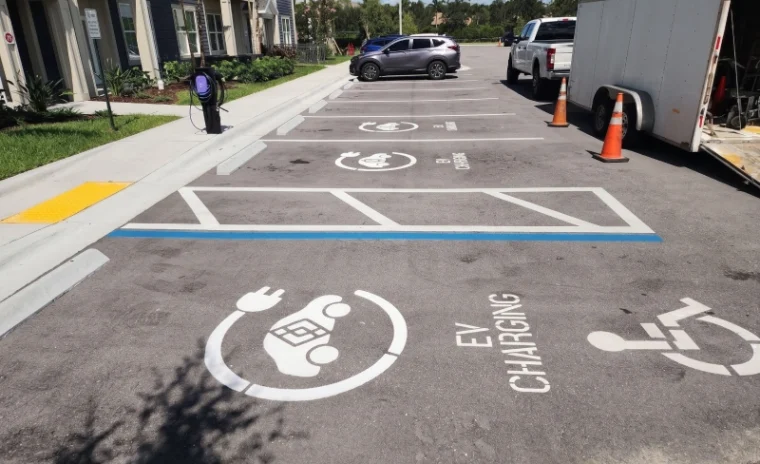
Incorrect spacing and dimensional errors represent one of the most frequent and expensive violations property owners face. ADA Standards for Accessible Design mandate specific width requirements: standard accessible spaces must be at least 96 inches wide, with an adjacent access aisle of at least 60 inches. Van-accessible spaces require 132 inches total (either 96-inch space with 96-inch aisle, or 132-inch space with 60-inch aisle). When these measurements fall short by even a few inches, the entire parking area can be deemed non-compliant.
The financial consequences extend beyond initial fines. Property owners may face ongoing penalties until corrections are made, legal fees from accessibility lawsuits, and mandatory repaving or restriping costs. In Florida’s intense summer heat, rushed or improper striping work often leads to premature fading, requiring even more frequent maintenance cycles. The humid subtropical climate accelerates paint degradation, making precision critical from the start.
Professional parking lot striping contractors utilize laser measurement tools and calibrated equipment to guarantee dimensional accuracy. They account for surface irregularities, drainage slopes, and material expansion that DIY approaches overlook. Experienced contractors understand that Palm Beach County properties face regular inspections, particularly in commercial districts where accessibility complaints trigger immediate review. Thermoplastic striping provides superior durability in Florida conditions, maintaining clear, measurable lines for years rather than months. When dimensions matter this much, professional verification protects your investment and your legal standing.
Faded or Non-Compliant Pavement Markings
Faded, worn, or incorrectly applied pavement markings create immediate compliance vulnerabilities and safety hazards. The International Symbol of Accessibility must maintain clear visibility and meet specific size requirements (minimum recommended height of 60 inches for surface-applied symbols). When markings fade to the point where drivers cannot easily identify accessible spaces, the facility effectively loses its accessible parking, regardless of original intent. This situation leaves property owners liable for lack of accessible parking even though spaces technically exist.
Florida’s weather patterns particularly challenge pavement marking longevity. Intense UV exposure, afternoon thunderstorms, and high humidity cycles can reduce standard traffic paint lifespan to 12-18 months in high-traffic areas. Properties near coastal regions, including much of the Palm Beach service area, experience accelerated deterioration from salt air exposure. Faded markings also create confusion for enforcement, leading to accessible spaces being used by unauthorized vehicles because boundaries are unclear.
Quality parking lot striping services recommend thermoplastic pavement markings specifically for accessible parking zones. Thermoplastic materials bond directly to pavement surfaces, resist UV degradation, and maintain color vibrancy significantly longer than conventional paint. These materials meet or exceed retroreflectivity standards, ensuring visibility in all lighting conditions. Contractors also document striping dates and material specifications, creating maintenance records that demonstrate good-faith compliance efforts. Regular inspection schedules, typically every 18-24 months, identify fading before it becomes a violation. Proactive restriping prevents complaints, maintains clear accessibility, and demonstrates your commitment to proper facility management.
Missing or Inadequate Accessible Parking Signage
Signage deficiencies rank among the most cited ADA violations during compliance audits. Regulations require that each accessible parking space be identified by a sign displaying the International Symbol of Accessibility, mounted at least 60 inches above the ground (measured to the bottom of the sign). Van-accessible spaces require additional “Van Accessible” designation. Signs must remain visible at all times and cannot be obscured by vehicles parked in the space. Many property owners mistakenly believe that pavement markings alone satisfy accessibility requirements, but vertical signage is mandatory regardless of surface symbols.
Missing or improperly mounted signs expose property owners to immediate citation and liability. Accessibility advocates and legal representatives actively survey commercial properties for violations, and signage errors are easily documented with photographs. In South Florida’s frequent severe weather events, signs can be damaged, knocked down, or obscured by vegetation growth, particularly during the rapid growing season from May through October. Properties that lack regular inspection routines often remain unaware of signage problems until a complaint is filed.
Professional street sign installation services ensure compliance with mounting height, visibility, and durability requirements. Contractors select corrosion-resistant posts and hardware suitable for coastal humidity and storm conditions common throughout the region. They verify clear sight lines from multiple approach angles and confirm that landscaping will not create future obstructions. Quality installation includes documentation of sign specifications and placement, creating an auditable compliance record. Periodic maintenance visits identify and address weather damage before it creates legal exposure, keeping your property continuously compliant.
Failing to Inspect and Maintain Striping Over Time
Parking stops, wheel stops, and curbing placement within accessible spaces and access aisles frequently create unexpected compliance failures and safety hazards. ADA guidelines prohibit any protrusions or obstacles within access aisles, as these interfere with wheelchair deployment and mobility device maneuvering. However, many property managers install parking stops at the front of every space, including accessible locations, without realizing this creates a violation. Improperly positioned stops also force vehicles to park farther back, reducing effective space width and potentially blocking access aisles. These seemingly minor placement errors generate significant liability if they prevent safe wheelchair access or cause injury.
The issue becomes more complex when considering surface transitions and drainage requirements. Florida properties must manage substantial rainfall, and parking lot grading often includes subtle slopes and drainage channels. When parking stops installation fails to account for these features, water pooling can render access aisles unusable during and after storms. Palm Beach area properties experience afternoon thunderstorms nearly daily during summer months, making drainage integration essential for year-round accessibility. Standing water in access aisles effectively eliminates accessible parking, creating immediate non-compliance.
Professional contractors evaluate the entire parking layout, including drainage patterns, before installing concrete parking stops. They understand that accessible spaces may require alternative stop placement or elimination of stops entirely within access aisles. Experienced teams coordinate with civil engineers when necessary to ensure that accessibility requirements and stormwater management work together rather than conflict. Proper placement documentation protects property owners by demonstrating that installations were performed according to current accessibility standards, providing a defense against claims of negligent design.
Protect Your Property with Professional Compliance
One of the most overlooked yet financially damaging mistakes is the failure to establish a regular inspection and maintenance schedule for parking lot striping and markings. ADA compliance is not a one-time achievement but an ongoing responsibility. Pavement markings deteriorate due to vehicle traffic, weather exposure, UV degradation, and surface wear. In Florida’s climate, intense sunlight and seasonal rainfall accelerate the fading of standard paint, reducing visibility and creating compliance gaps that expose property owners to liability.
Many facility managers mistakenly believe that once striping is installed, it remains compliant indefinitely. However, faded or barely visible markings fail to meet accessibility standards and can result in citations during inspections or ADA complaints from visitors. Regular audits should assess line clarity, symbol visibility, signage condition, and surface integrity. Property owners should document these inspections to demonstrate due diligence in maintaining compliance.
Professional parking lot striping services offer scheduled maintenance programs that include inspection, touch-up, and full re-striping as needed. Thermoplastic striping provides a durable alternative to paint, offering extended lifespan and superior visibility retention, particularly valuable for high-traffic facilities in the Palm Beach region. Investing in quality materials and proactive maintenance prevents costly emergency repairs, legal penalties, and reputational damage. Establishing a partnership with qualified parking lot striping contractors ensures that your facility remains compliant year-round, protects your investment, and provides safe, accessible parking for all users. Regular maintenance is not just about compliance, it is about demonstrating a commitment to accessibility and community responsibility.